AI AutomationBy Nacho Nayar · 7 min read
AI agents vs. simple automation: which one does your business need
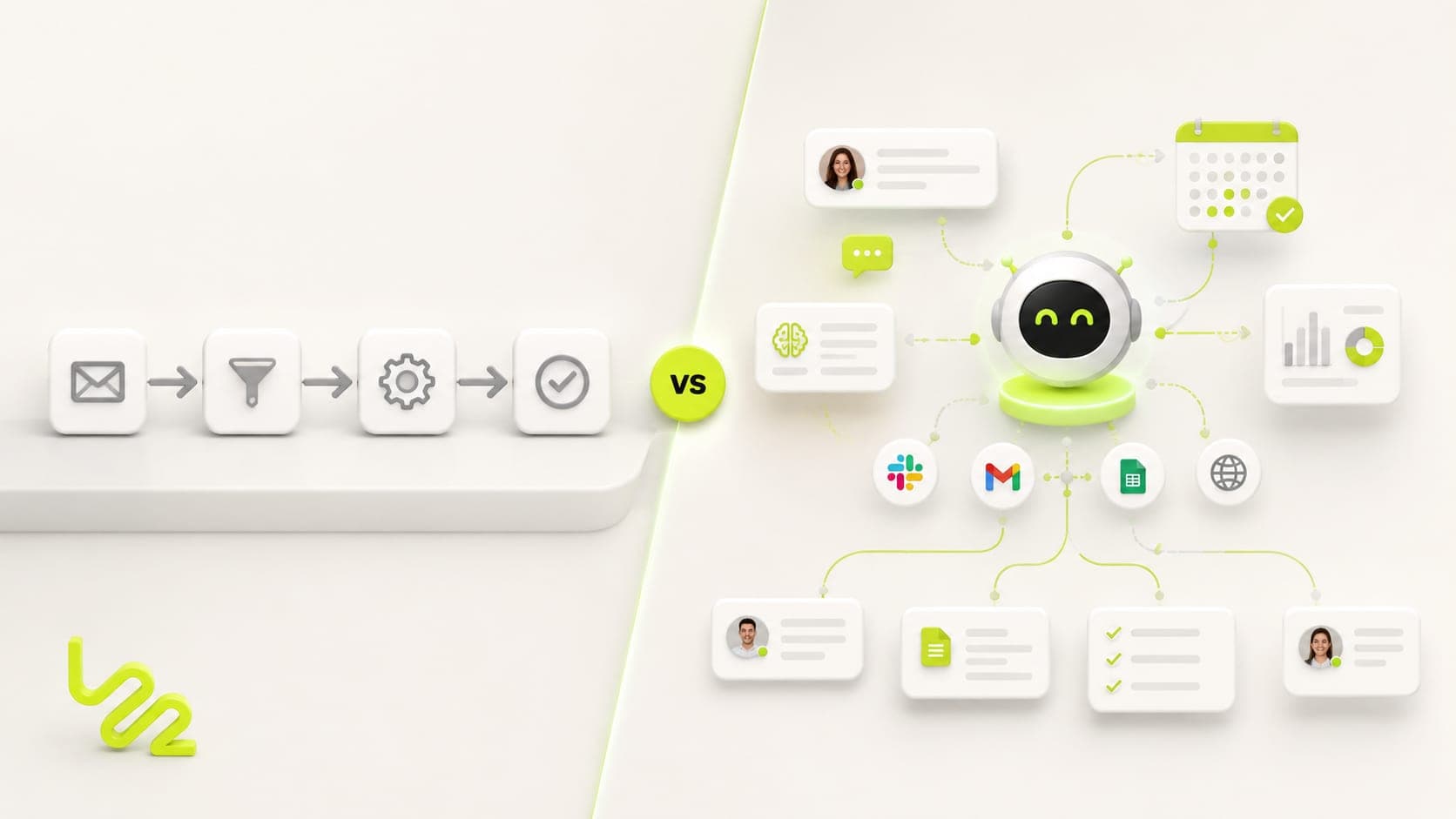
"Automation" and "AI agent" aren't synonyms, even though today they're sold as if they were. A workflow follows fixed rules: if A happens, do B, the same way every time. An AI agent understands free-form language, decides on the fly, and adapts to questions nobody wrote down in advance. Mixing the two up leads a small business to overpay for a chatbot when a USD 600 workflow would've done the job — or to get stuck with a rigid flow when what it actually needed was something that understood natural language.
The question isn't which technology is better: it's which one solves your process without overpaying or falling short. Here's the real difference, with examples and how to decide before asking for a quote.
Key takeaways
- A workflow follows fixed, predictable rules: same input, same output, every time. An AI agent interprets free-form language and decides case by case.
- If your process can be drawn as a yes/no diagram, a simple workflow is enough and costs less: from USD 600.
- If the process involves understanding what someone writes in their own words, you need a conversational agent: from USD 1,000, within the automation service.
- A poorly scoped agent — without a clear knowledge base — makes things up. A simple workflow never does, because it doesn't interpret: it executes.
- Most small businesses need both: workflows for what's repetitive and predictable, an agent for what comes in as natural language.
- Starting with the cheapest workflow to build usually pays for itself before you even decide whether an agent is worth adding.
The real difference, without the marketing
A workflow is a recipe: when an invoice arrives, it reads it, pulls out the amount, and loads it into the spreadsheet. If the document doesn't match the expected format, the workflow flags it for a human instead of guessing. It doesn't reason or interpret nuance — it executes predefined steps, which is exactly why it's cheap, fast to build, and 100% predictable.
An AI agent, on the other hand, receives a query written the way any person actually writes — typos, no structure, implicit context — and decides what to answer or do based on a knowledge base trained on the business's real information. It's the difference between a form with fixed fields and an actual conversation.
When a simple workflow is enough
If you can draw your process as a flowchart with fixed steps — "if the order is over a certain amount, request approval; if not, invoice directly" — you don't need an agent. A rule-based workflow handles automatic reports, data loads between systems, email follow-up sequences, and form validations. It's built in days, starts at USD 600, and has zero room for interpretive error: it does exactly what was programmed, nothing more, nothing less.
When you need a conversational agent
When the process starts with an open-ended question — a customer writing "do you have this in size M and can I pay in installments?" — no rule-based workflow covers every way of asking the same thing. That's where you need an agent trained on real prices, stock, policies, and hours, capable of holding a conversation and handing off to a person when the case falls outside what it knows. It starts at USD 1,000, within the same AI automation service.
Three examples to help you decide
Loading receipts into an accounting system is a simple workflow: the invoice format doesn't change, the validation rules are fixed, and an agent there would mean overpaying for a capability — understanding free-form language — the process doesn't need.
Answering WhatsApp questions outside business hours is the opposite: every customer asks differently, in their own words, and a fixed-rule workflow could only cover the most frequent questions literally — any variation slips through. That's where the agent belongs.
The middle case, and the most common one: a workflow that triggers an agent only when needed. An order that comes in through a structured form gets processed with fixed rules; if the customer adds a note in the comments field, an agent reads it and decides whether the order needs to be flagged for review. It's not one or the other — it's using each tool where it earns its keep.
The risk of choosing wrong
Putting an agent where a simple workflow would've done doesn't break anything, but it makes the project more expensive and adds a monthly usage cost you didn't need to pay. The costlier mistake goes the other way: forcing a fixed-rule workflow to cover an actual conversation. That's where you get option menus nobody uses, forms that don't understand the question, and customers who type "talk to a person" in their very first message.
The question that settles it isn't "what's more modern?" but "does my process start with a fixed rule or an open question?" The answer defines the tool, not the other way around.
How to decide for your case
Write the process you want to automate in a single sentence. If that sentence has a clear, unambiguous "if… then…", it's a simple workflow. If it includes "depends on what they ask" or "depends on how they phrase it", it's an agent. And if your process has both parts — a structured input and moments of free-form language — you probably need both, starting with whichever is cheaper to build and faster to measure.
Frequently asked questions
Can an AI agent replace all my automation workflows?
It's not worth it: using an agent for fixed-rule tasks means overpaying for a capability you don't need. Simple workflows remain the cheapest, most predictable option for processes without ambiguity.
How do I know if my business needs a conversational agent?
If your customers write questions in their own words — over WhatsApp, email, or a free-text form — and those questions vary a lot, a fixed-rule workflow won't cover the real cases. That's where an agent pays off.
Can I start with a simple workflow and add an agent later?
Yes, and it's the most common path: automate what has clear rules first, measure the savings, and add a conversational agent once the volume of free-form questions justifies it.
Can a poorly trained AI agent give out wrong information?
Yes, if its knowledge base isn't well defined. That's why an agent needs the business's real information — prices, stock, current policies — and clear rules for when to hand off to a person instead of answering with what it doesn't know.
Which is more expensive to maintain, a simple workflow or an agent?
A simple workflow needs almost no maintenance unless your systems change. An agent needs its knowledge base updated when prices or policies change, adding some ongoing work in exchange for covering a range of questions a fixed workflow can't.
If you're not sure which one your process needs, tell us how it works today and we'll tell you whether a rule-based workflow is enough or you need a conversational agent, with a closed quote from the first diagnosis. At loco22 we design and build both, always starting with the cheapest option that solves the real problem.
Found this useful? Add us as a preferred source in Google.