AI AutomationBy Nacho Nayar · 9 min read
AI Chatbot for WhatsApp: What It Can Do for Your Business (With Examples)
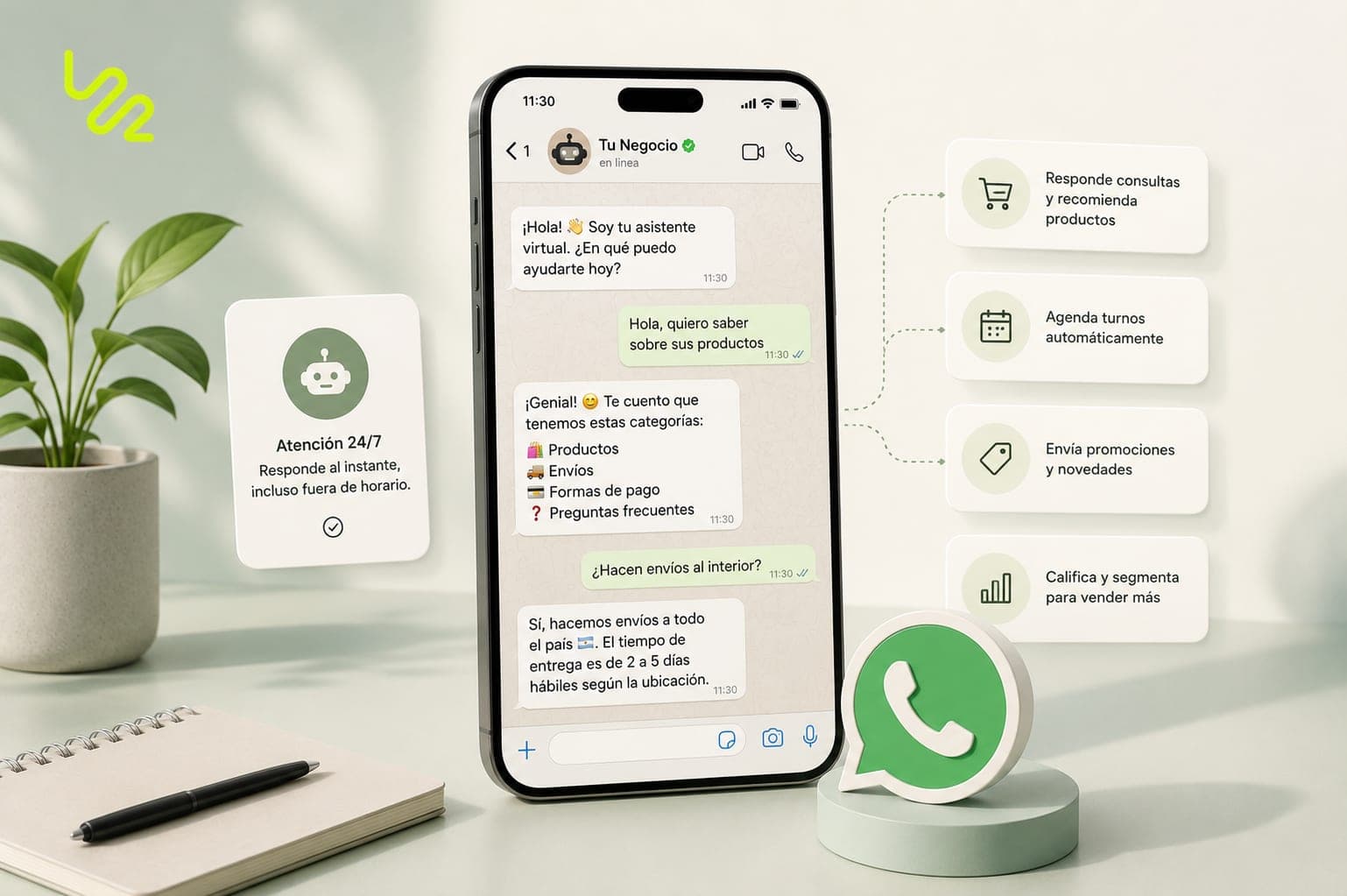
An AI chatbot for WhatsApp is an agent trained on your business's real information that answers questions, qualifies leads, and books appointments in seconds, any time of day, with no human involved. It's not the old "press 1 for sales" menu bot — it understands your customers' natural language and answers the way your best salesperson would on their best day.
In Argentina, and across most of Latin America, deals get closed on WhatsApp. They're also lost there: a question comes in at 10:47 PM and gets answered the next day at noon, by which point the customer already bought somewhere else. In this guide we cover what an AI agent can do for your business, what you shouldn't hand off to it, what it costs, and how to implement it.
Key takeaways
- An AI chatbot on WhatsApp answers repetitive questions — prices, stock, shipping, hours — in seconds, using your business's real information, 24 hours a day.
- Unlike the classic menu bot, an AI agent understands natural language: it parses "hey, do you ship to Rosario? how much is it?" without forcing anyone to press a number.
- Beyond answering questions, it can qualify leads, book meetings on your calendar, follow up on cold conversations after 48 hours, and take simple orders.
- Sensitive complaints and negotiations get handed off to a human with full context — the projects that fail are the ones that try to automate 100% of it.
- An AI chatbot for WhatsApp starts at USD 1,000 for setup plus a small monthly platform fee, and it's up and running in 2 to 3 weeks.
- If your business handles more than 20 inquiries a day, the investment pays for itself in the first month.
What is an AI chatbot for WhatsApp?
It's software that combines three pieces: a language model (the same technology behind ChatGPT or Claude), a knowledge base loaded with your business data — prices, catalog, policies, hours — and an official connection to WhatsApp through the WhatsApp Business API. The result is a phone number that answers on its own, using your data and your tone.
This isn't the menu bot you hate
We've all suffered through the "press 1 for sales" bot: a rigid decision tree that understands nothing and ends in "I didn't understand your request." Today's AI agents use language models: they understand questions written the way people actually write them, answer with your real data, and hand off to a human when the topic calls for it. The difference in experience is night and day.
What can an AI chatbot do for your business?
- Answer frequently asked questions with your information: prices, stock, hours, shipping and return policies.
- Qualify leads: ask what they need, by when, and with what budget, then pass you only the contacts worth your time — logged in your CRM or spreadsheet.
- Book meetings or appointments straight into your calendar, back-and-forth included.
- Follow up: re-engage conversations that went cold with a message 48 hours later.
- Take simple orders and push them into your system, ready to invoice.
None of this is brochure talk — these are features that get built today with mature, stable tools. The key isn't the technology, it's the training: an agent fed old or incomplete information answers fast, but answers badly. That's why half the project is getting your information in order before connecting anything.
Concrete examples by industry
E-commerce and stores
The agent answers questions on stock, sizes, payment methods, and shipping times; reports order status; and if a customer hesitated, follows up the next day with the answer they were missing. "Is this in stock?" questions that today die unanswered on a Sunday night turn into Monday's sales.
Appointment-based services
Salons, healthcare, workshops, professionals: the bot offers open calendar slots, books, confirms, and sends a reminder before the appointment. Fewer back-and-forths to coordinate, and fewer no-shows — which in appointment-driven businesses are straight-up lost money.
Real estate agencies and dealerships
Here the value is in filtering: the agent asks about area, budget, and payment method, weeds out the window-shoppers, and books viewings only with genuinely interested leads. Your salesperson stops repeating the same info about the same property forty times a day and spends that time closing deals instead.
What you shouldn't hand off to it
Sensitive complaints, price negotiations, angry customers: there the bot has exactly one job — recognize the moment and hand off to a human with the full context of the conversation. A good agent knows when to stay quiet; the projects that fail are the ones that try to automate 100% of it.
Handing off isn't a shameful patch — it's part of the design. You define upfront what triggers a handoff to a human — a complaint, a big-ticket amount, a flagged word — and the agent passes along the conversation with a summary included, so your team isn't asking "how can I help you?" for the second time.
The numbers that matter
- Response speed: from hours to seconds. In plenty of industries, whoever answers first wins the sale.
- Coverage: 24/7, weekends and holidays included. No need to grow the team.
- Consistency: the bot never answers in a bad mood or quotes an outdated price.
- Measurement: every conversation gets logged; you know what people ask and where sales stall.
That last point is the most underrated: two months in, you have an exact map of what your market asks about and where sales fall through. That information is worth as much as the automated answers — and it feeds your website, your ads, and your catalog.
How much does an AI chatbot for WhatsApp cost?
An agent trained on your business's information, connected to the WhatsApp Business API and to your calendar or CRM, starts at USD 1,000 for setup plus a small monthly cost for the platform and model usage. Price scales with complexity — billing integrations, very large catalogs, or full sales flows get quoted separately, with a fixed scope.
The math is simple: if someone on your team spends two hours a day answering the same ten questions, that's over 40 hours a month. If you handle more than 20 inquiries a day, the chatbot pays for itself in the first month — and stops losing that 10:47 PM question along the way.
How is it implemented? Step by step
- Discovery: we gather the real questions from your current WhatsApp — the 20 most repeated ones and how your best salesperson answers them.
- Knowledge base: we load prices, catalog, shipping and return policies, hours, and brand tone. You approve it before the bot says a single word.
- Connection: a number on the WhatsApp Business API, plus integrations with your calendar, CRM, or spreadsheet.
- Internal testing: your team tries to break it for a week — weird questions, complaints, edge cases.
- Gradual rollout: the agent starts answering live, and the first few weeks it gets fine-tuned with real conversations.
From the first meeting to having the agent live takes 2 to 3 weeks, depending on how organized your information already is. The finer work isn't technical — it's deciding what it answers, how it says it, and when it raises its hand to call in a human.
What to ask before hiring a chatbot
- Does the bot only answer with my information, or does it improvise? The right answer: it responds from a controlled knowledge base and hands off when it doesn't know.
- How do I update prices and stock? It should be quick and simple, without depending on a developer for every change.
- What happens to the conversations? They need to be logged and be yours — that's where the gold is, knowing what people are asking for.
- Do the number and account stay in my name? Same as with your website: if you switch providers tomorrow, the channel is still yours.
- What reports does it deliver? At minimum: conversations handled, handoffs, qualified leads, and unanswered questions.
Your customer doesn't want to talk to a robot. They want an answer now. If a well-trained robot gives it to them, everyone wins.
Frequently asked questions
Can the chatbot answer with my real prices?
Yes — the AI agent answers from a knowledge base loaded with your current prices, stock, and policies, which you can update whenever they change. It doesn't make up numbers — if a piece of data isn't in its knowledge base, it says so and hands off the question. And if your prices change often, it can connect directly to your spreadsheet or system to always read the current value.
What happens if the bot doesn't know the answer?
A well-configured AI agent recognizes when it doesn't have the data, says so honestly, and hands off the conversation to someone on your team with a summary of what was discussed. Those unanswered questions also get logged — reviewing them weekly is how you expand the knowledge base and make the bot a little better each time.
Do I need the WhatsApp Business API, or is the regular app enough?
To automate seriously, you use the WhatsApp Business API, Meta's official way to connect software to the channel. The regular app isn't built for bots, and using it with workarounds risks getting your number blocked. The good news: you can keep your current number, and the migration is a standard part of the setup.
Can the chatbot book appointments on my calendar?
Yes — the agent connects with Google Calendar or other scheduling tools, offers only genuinely open slots, confirms the appointment, reschedules it if the customer asks, and sends reminders. For appointment-driven businesses — healthcare, salons, services — this is usually the feature that recovers the most money, because it cuts no-shows.
How much does it cost to run an AI chatbot per month?
After the initial setup — starting at USD 1,000 — there's a small monthly cost for the platform and AI model usage, which depends on conversation volume. For a typical small business, we're talking tens of dollars a month, not hundreds. Compare that to the hours someone spends answering the same questions every day.
Can the same agent handle Instagram and my website too?
Yes — the same brain, the knowledge base and handoff rules, can connect to WhatsApp, Instagram, and a chat widget on your website. In Argentina, WhatsApp is where sales actually close, so we usually start there and add the other channels later, without duplicating the training work.
If you want to see this working with your own questions, at loco22 we build a demo loaded with your business's real information: you message it as if you were your own customer and judge the answers for yourself. No commitment, and a fixed quote if you decide to move forward. The first step is a free consultation — over WhatsApp, obviously.
Found this useful? Add us as a preferred source in Google.