AI AutomationBy Nacho Nayar · 9 min read
AI automation for small businesses: 7 processes you can hand off today
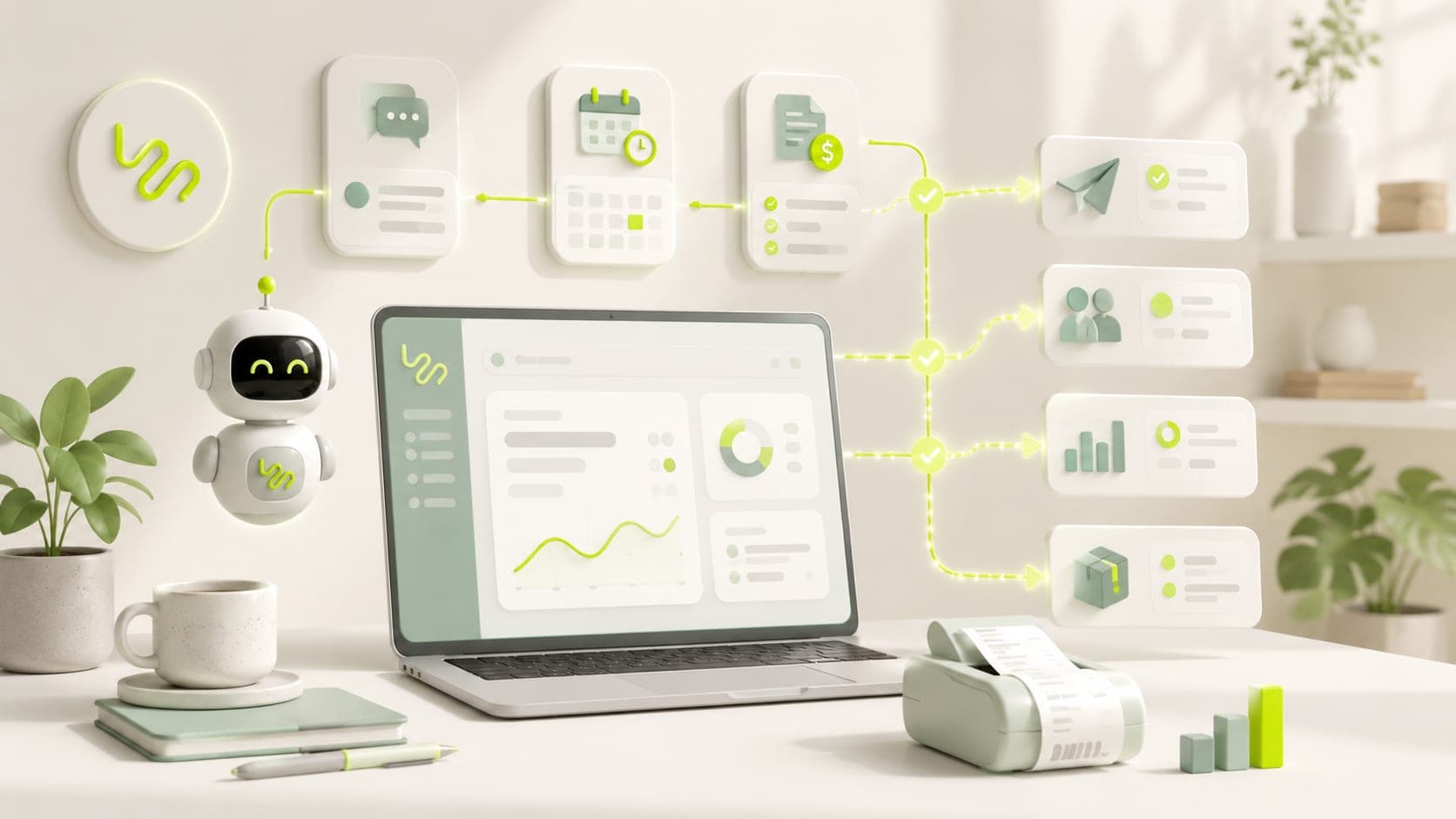
AI automation for small businesses means using smart flows and agents to hand repetitive work off to software — answering inquiries, qualifying leads, logging invoices, building reports — without hiring your own developers or migrating your systems. With tools like n8n and Make plus today's language models, this stopped being the exclusive territory of corporations with an IT department a while ago.
In this guide we run through the seven processes where we see small and medium businesses in Argentina save the most hours, ranked by impact, with concrete examples, real prices, and the golden rule for not blowing it up in the attempt.
Key takeaways
- AI automation lets a small business hand off repetitive work to software flows and agents, using platforms like n8n and Make connected to the tools it already uses.
- The seven highest-impact processes are: handling inquiries, lead qualification, quotes, reports, invoice entry, post-sale follow-up, and first-draft content.
- A chatbot trained on your actual business info answers 70-80% of repeat inquiries, on the website or WhatsApp, any hour of the day.
- A simple automation flow starts at USD 600 and an AI chatbot from USD 1,000; with real work volume, they pay for themselves in weeks.
- The golden rule is to start with a single process, measure the hours before and after, and only then scale to the next one.
- AI doesn't replace your team's judgment: it takes off their plate the part of the work a machine does better, faster, and without getting bored.
What is AI automation (and what isn't it)?
Automating with AI means connecting the tools you already use — email, spreadsheets, WhatsApp, your online store, your CRM — through flows that move information on their own, and adding language models capable of understanding free-form text: a messy email, an invoice as a PDF, an inquiry typed in a rush. The machine handles the repetitive part; the important decision is still yours.
What it isn't: it's not replacing your team, it's not a magic robot running the company, and it's not a six-month project with endless consultants. A well-chosen flow gets implemented in days or weeks and targets one specific pain point. That also makes it easy to measure: hours saved, errors avoided, sales that used to slip away.
n8n, Make, and agents: the toolkit
n8n and Make are automation platforms: the glue that connects hundreds of applications to each other without coding from scratch. Language models — the tech behind ChatGPT or Claude — add the piece that used to be missing: understanding unstructured content. Combine the two and processes that were impossible three years ago become automatable.
1. Handling frequent inquiries
A chatbot trained on your business's real information (prices, hours, stock, policies) instantly answers 70-80% of the questions that currently interrupt your team — on the website or on WhatsApp, at 3 in the afternoon or 3 in the morning. It's process number one for a simple reason: it's where the results show up fastest.
The side effect is just as valuable: every conversation gets logged. Two months in, you know exactly what people ask, what's stalling purchases, and what you need to clarify on your site.
2. Lead qualification
Not everyone who writes in is a potential customer. An AI agent asks the qualifying questions — what they need, by when, with what budget — filters out what doesn't apply, and hands you only the leads worth your time, loaded straight into your CRM or a spreadsheet. Your salesperson stops burning the morning filtering the curious and spends it closing instead.
This hits twice as hard if you run paid ads: every lead from Google Ads or Meta Ads that goes cold without a reply is money down the drain. With automatic qualification, the contact gets handled in the first minute, when buying intent is hottest.
3. Quotes and estimates
If your quotes follow a logic — price per square meter, per hour, per volume, per unit — an automated flow can generate and send them in minutes, with your template and your branding. The classic "I'll send the quote tomorrow" becomes "check your email." In industries where whoever quotes first wins, this alone justifies the project.
Think of a hardware supplier, a print shop, or a studio that bills by the hour: the formula already exists, it lives in the owner's head or in an Excel file. Automating it doesn't change the price — it changes whether the client gets it in five minutes instead of two days.
4. Reports nobody wants to build
Weekly sales, critical stock, active campaigns, pending collections: the information exists, but someone loses two hours every Monday pulling it together from three different systems. A flow gathers it automatically, summarizes it with AI, and drops it in your inbox or on Slack every Monday at 8am. Nobody misses building reports; nobody notices the savings more.
5. Data and invoice entry
AI reads invoices, delivery notes, and receipts — PDF, photo, email — and loads the data wherever it belongs: spreadsheet, accounting system, ERP. Doubtful cases get flagged for human review instead of slipping through. Less typing, fewer transcription errors, and your admin team spent deciding instead of copying numbers from one place to another.
6. Post-sale follow-up
The thank-you email, the review request 7 days later, the repurchase reminder a month out: sequences that sell themselves and that no human keeps up manually for more than two weeks. Automated, they run forever. And the reviews they collect don't just bring in new customers: they feed your local SEO and your visibility in AI search engines.
7. First-draft content
Product descriptions, review replies, posts, campaign emails. AI doesn't replace your judgment or your voice, but it turns a blank page into a decent draft your team can edit in minutes. For a store with 300 products with no description, the difference between "we'll get to it someday" and "it's done" is exactly this automation.
How much does it cost to automate processes with AI?
A simple automation flow — an automatic report, a follow-up sequence, invoice entry — starts at USD 600. A chatbot or AI agent trained on your business, from USD 1,000. On top of that there's a small monthly platform and model-usage cost, which scales with work volume.
The math works out in hours: if a USD 600 flow saves your team 5 hours a week, that's over 20 hours a month starting the first month. It pays for itself in weeks, not years — and unlike a new hire, it doesn't quit, doesn't get sick, and doesn't take vacation.
Where to start (and where not to)
Start with ONE process: the one that steals the most time or costs you the most sales. Measure the hours before and after. Once the first flow proves its worth, scaling to the rest comes naturally. The classic mistake is the opposite: trying to automate everything at once, overwhelming the team, and finishing nothing.
A good first candidate meets four conditions:
- It repeats every day or every week, always with the same logic.
- It steals hours from someone whose time is worth more on another task.
- It has clear rules: if A happens, do B. Exceptions get routed to a human.
- Its result can be measured: hours saved, replies sent, errors avoided.
The question isn't whether AI can do the task. It's how many hours a week you're paying a bored human to do it.
Frequently asked questions
Do I need to know how to code to automate my small business?
No: platforms like n8n and Make work with visual flows, and the agency handles the implementation. Your part is contributing business knowledge — how you quote, what you answer, what makes a good lead — and validating the results. Once delivered, running the flows requires no technical knowledge at all.
Does automation work with the tools I already use?
Generally, yes: n8n and Make connect to hundreds of applications — Google Sheets, Gmail, WhatsApp, Tienda Nube, Mercado Libre, CRMs, and accounting systems, among others. And when a tool doesn't have a direct connector, it can almost always be solved via API or email. The practical rule: if the data goes in or out somewhere, it can be automated.
How long does it take to implement an automation flow?
A simple automation flow — automatic report, follow-up sequence, receipt entry — gets implemented in a matter of days to two weeks. A chatbot trained on your business, in 2 to 3 weeks. Projects involving integrations with old or custom systems take longer and get budgeted separately, with scope locked down before starting.
Can AI make mistakes entering data or replying?
It can, like any system — and like any person typing at seven in the evening. That's why serious flows include automatic validations and human review of doubtful cases: AI handles the volume and flags the exceptions. In practice, that combination makes fewer mistakes than manual entry, and every error gets logged and corrected.
Is it worth automating if we're only three people?
The smaller the team, the more every repeated hour hurts: in a three-person small business, whoever answers inquiries or enters invoices is usually the owner. An automation flow starting at USD 600 is considerably cheaper than your first hire, and it frees up exactly the hours of the person generating the most value selling or producing.
What happens if I switch systems or change my prices?
Automation flows adjust: swapping a connector or updating a chatbot's knowledge base is hours of work, not a new project. That's why it pays to document each flow and work with a provider who delivers them in your name — if you switch agencies tomorrow, the automation is still yours.
If this hit home, the next step is simple: tell us which process is stealing the most hours from you, and in a free consultation we'll tell you whether it's worth automating, with which tool, and with a locked-in budget. At loco22 we design and implement AI flows and agents for small businesses — starting with one, measuring, and scaling only when the numbers add up.
Found this useful? Add us as a preferred source in Google.