AI AutomationBy Mariano González Campas · 10 min read
Where to start digitizing your business (and in what order)
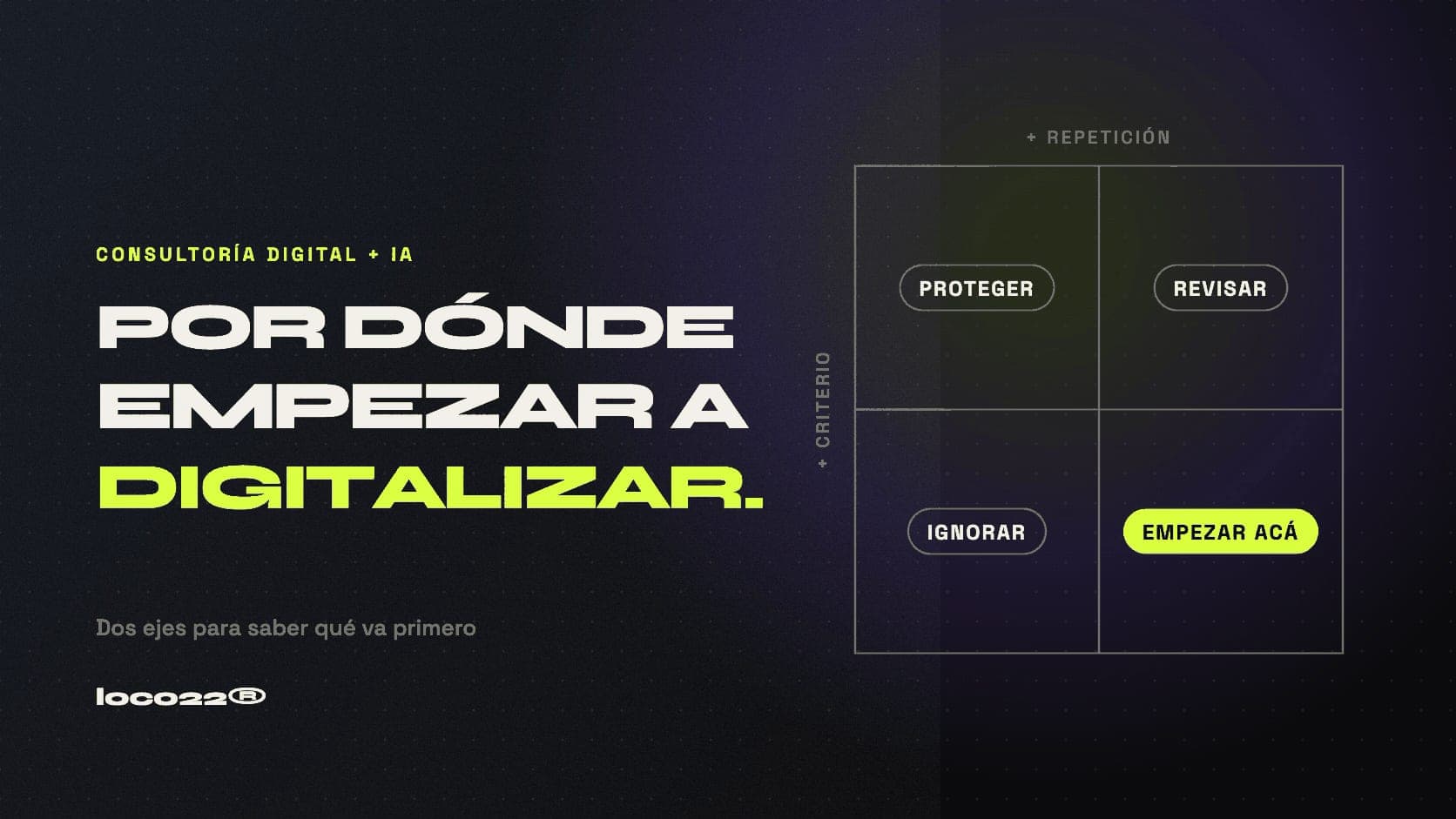
Digitizing a business isn't about buying software: it's about deciding the order in which you tackle your processes. Most projects that fail don't fail because of the tool, they fail because of the order — they started with the flashiest thing instead of the most profitable one, and two months later nobody was using it.
This guide explains the rule we use to decide what goes first: a two-axis matrix you can build in an afternoon, and which almost always contradicts the team's intuition. It covers the three costliest mistakes, how to calculate return using your own numbers, and what to expect from a professional diagnosis.
Key takeaways
- Order matters more than the tool: the first project decides whether your team adopts digitization or resists it for years.
- The rule is two axes: how often a task repeats and how much human judgment it needs. High repetition and low judgment goes first.
- Work that needs a lot of judgment and repeats rarely doesn't get automated: it gets protected. That's where your team's value lives.
- In the middle zone, AI assists but doesn't decide: it proposes and a person approves.
- The costliest mistake is automating a broken process; the second is buying the tool before defining the problem.
- Return is calculated with your hours and your cost per hour, not with internet averages or someone else's case study.
- A serious diagnosis takes weeks, not months, and ends in a prioritized roadmap with a price per stage.
Why order matters more than the tool
When a company starts digitizing, the same thing usually happens: someone sees an impressive demo, gets excited, signs up for the platform, and two months later nobody opens it. The conclusion the company draws is «this doesn't work for us». The correct conclusion is different: a solution was bought before the problem was defined.
The first digitization project isn't just a project: it's the test your team uses to decide whether this is worth it. If the first one works and takes a task they hated off their plate, the second one gets requested on its own. If the first one is a huge project that drags on for months and creates extra work, every later proposal starts with the team against it. That's why the selection criteria is the most important decision in the whole process.
The two-axis rule
Put all of your company's tasks on a chart with two axes: how often each one repeats, and how much human judgment it needs to be done well. You don't need statistical precision; it's enough for the team to place them from memory in a one-hour meeting. The map that emerges is usually surprising.
High repetition, low judgment: this is where you start
This is the quadrant of tasks done dozens of times a week that any trained person solves the same way: moving form data into the system, answering the same five questions, sending appointment or payment reminders, building the monthly report with the same numbers as always.
These tasks have three virtues for a first project: the savings are easy to measure, the risk of getting it wrong is low, and the team is grateful to have them taken away. They aren't the most interesting tasks in the company — which is exactly the point.
High judgment, low repetition: don't touch this
Negotiating with a difficult client, pricing a large proposal, resolving a delicate complaint, deciding who to hire. These happen rarely and depend on context, experience and relationships. Automating them saves no meaningful time and does destroy what makes your company good.
This quadrant doesn't get automated: it gets protected. In fact, the point of digitizing everything else is to free up hours so your people spend more time here.
The middle zone: AI proposes, a person approves
Between the two extremes sits work that repeats fairly often and needs some judgment: drafting a first reply to a complex inquiry, preparing a proposal draft, sorting complaints by urgency, summarizing a long meeting. This is where generative AI genuinely delivers, with one condition: it proposes and a person approves before anything goes out.
That review step is what separates a serious implementation from a dangerous experiment. It's also what makes adoption viable: the team keeps control and sees the benefit without feeling replaced.
The three costliest mistakes
1. Automating a broken process
This is the most common and most expensive mistake. The company has a circuit that limps along, full of exceptions and of «someone fixes that manually when it happens». They automate it exactly as-is, and the result is that errors now happen faster and at greater volume, with nobody in the middle to catch them.
Before automating, you have to tidy up. And while tidying up, you often discover that part of the process wasn't needed at all: that part doesn't get automated, it gets deleted. Automating is the last step, not the first.
2. Buying the tool before defining the problem
The right question isn't «which AI tool should I use?». It's «which task eats the most hours and needs the least judgment?». The tool gets chosen after that answer, and it often turns out the one you already pay for is enough.
3. Starting with a project that's too big
An eighteen-month full transformation plan sounds great in a presentation and dies in month four. A small automation that works convinces people more than a huge plan that never gets going. Automate one task, measure the time saved, and use that number to decide the next one.
How to calculate return with your own numbers
You don't need a study: you need a stopwatch. For one week, measure how much time the candidate task actually takes. Don't estimate it from memory, because repetitive tasks are always underestimated.
Then multiply those weekly hours by the cost per hour of whoever does them, and by the weeks in a year. That's the annual cost of continuing to do it by hand. Compare that number to the price of the automation and you'll have your payback period in months, calculated with your company's data instead of someone else's.
If the math doesn't work with your own numbers, that process wasn't the first one. Find another: there's always one that does work.
This calculation has an added benefit: it gives you the argument to convince whoever has to approve the investment. «It saves us time» convinces nobody; «this task costs us this many hours a month and pays for itself in this many months» does.
What to expect from a professional diagnosis
You can build the matrix yourself, and for a small company that's often enough. When the team is larger or processes cross several areas, an outside perspective helps: the people doing the work every day have normalized the exceptions and take them for granted.
A serious diagnosis looks nothing like traditional consulting with months of meetings and an eighty-page report nobody executes. It should look at your real processes, talk to the people who run them, measure where the hours go, and end in a roadmap prioritized by return: what goes first, what comes later, what shouldn't be touched, and what each step costs.
Our digital + AI consulting runs three weeks with a delivery date and starts at USD 1,500, with a fixed price agreed before we begin. You end up with a 90-day plan you can execute with us or with whatever team you choose: the roadmap is yours.
Frequently asked questions
Where do I start digitizing my business?
With the task that repeats most and needs the least human judgment. Place all your tasks on two axes — repetition and judgment — and start with the high-repetition, low-judgment quadrant: moving data, answering the same questions, sending reminders, building reports. That's where savings are easy to measure and risk is low.
How long does it take to digitize a company's processes?
It depends on scope, but the first automation should be running in weeks, not months. A full process diagnosis takes about three weeks; from there, each individual automation is usually implemented in days or a few weeks depending on complexity.
How much does it cost to digitize a small business?
A single automation starts at USD 600, and a full process diagnosis with a 90-day roadmap starts at USD 1,500. The return depends on how many hours a week the task currently consumes: multiply those hours by the cost per hour of whoever does them and you'll have your payback period.
Which processes should NOT be automated?
The ones that need a lot of human judgment and repeat rarely: negotiations, pricing decisions on large proposals, delicate complaints, hiring. Automating them saves no meaningful time and degrades the quality of what makes your company good. That work gets protected, not handed to software.
Do I need to replace the systems I already use?
Usually not. Most automations connect the tools a company already has — email, spreadsheets, WhatsApp, CRM, invoicing — rather than replacing them. Migrating systems is a separate, far more expensive project, and it's rarely the right first step.
In short
Digitizing well is a matter of order. Place your tasks by how much they repeat and how much judgment they need, start with the easy quadrant, tidy the process before automating it, and measure the result with your own numbers. If the first project pays for itself, the rest of the road gets walked with the team on your side.
Found this useful? Add us as a preferred source in Google.