SEO + AIBy Mariano González Campas · 11 min read
Why your website doesn't show up on Google (and how to fix it)
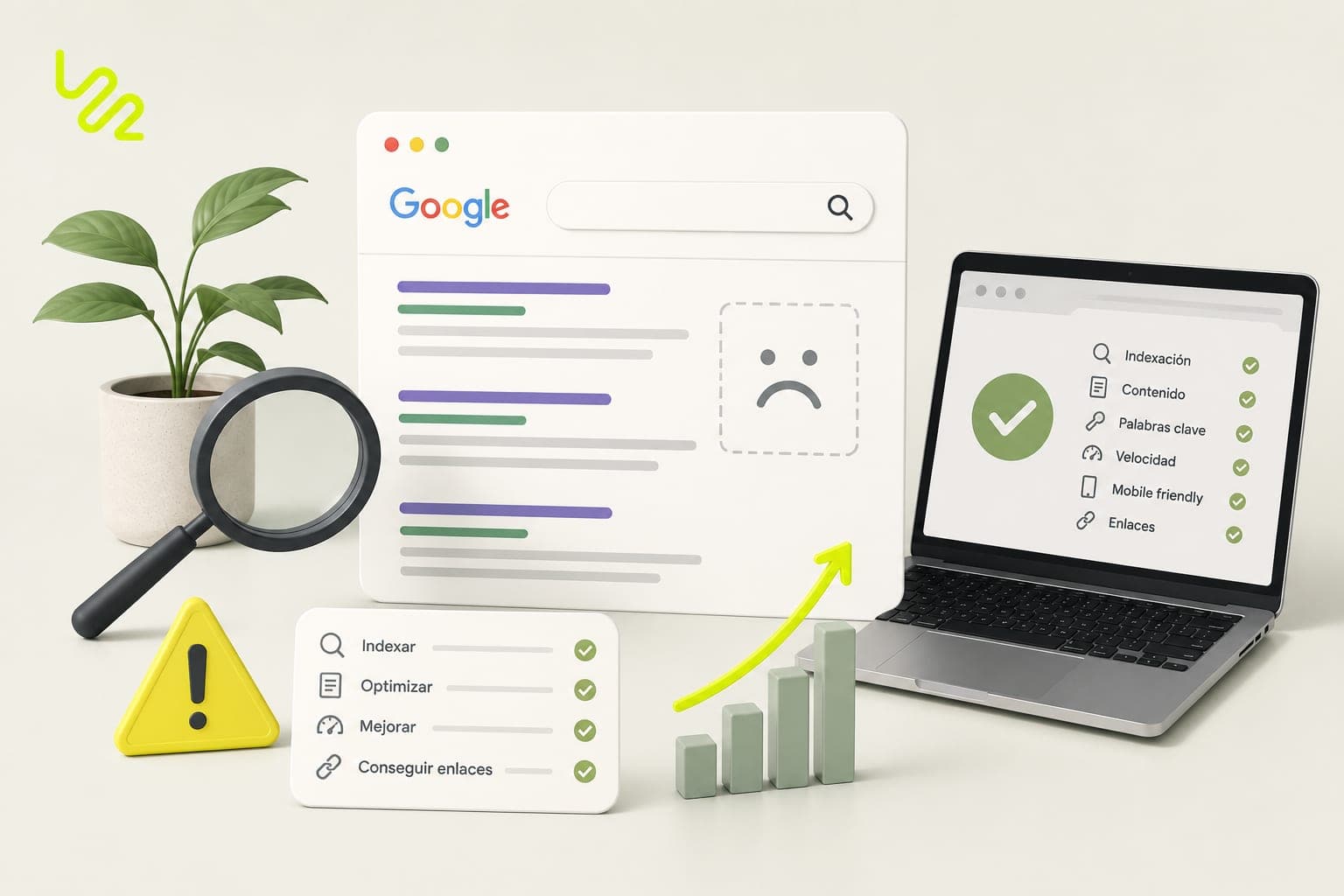
If your website isn't showing up on Google, the cause is almost always one of these nine: no indexing, slow load times, content that doesn't answer searches, sloppy titles, duplicate or too-thin text, zero authority, dependence on JavaScript, impossible-to-win keywords, or — the newest one — an AI summary that keeps the click. All of them can be diagnosed for free in 15 minutes, and several get fixed in an afternoon. "I've had a website for two years and nobody finds me" is the phrase we hear most at loco22 — and behind it there's almost never a mystery: there's a to-do list.
In this guide we go cause by cause, from most serious to most subtle, with the symptom, the diagnosis, and the fix for each one. You don't need to know how to code: a browser, PageSpeed Insights, and an uninterrupted half hour will do.
Key takeaways
- Before talking rankings, check indexing: if you search site:yourdomain.com on Google and nothing shows up, your site isn't even in the index.
- Load speed is a ranking factor: a site scoring red on mobile in PageSpeed Insights loses rankings and visitors at the same time.
- Google ranks pages that answer specific searches: every important service your business offers needs its own page with real content.
- No authority, no ranking: links, mentions, and reviews from other sites are the vote of confidence Google needs to recommend you.
- Experts agree that serious SEO takes three to six months to show sustained results; "first page in two weeks" is smoke and mirrors.
- Long, specific searches bring less traffic but more buyers: for a new website they're the winnable path, not generic keywords.
- Since 2026 there's one more cause: you can rank high and still get no visits, because the AI summary already answered the question. You spot it by high impressions with a CTR near zero.
1. Is your website indexed on Google?
Indexing is the step before any ranking: if Google hasn't saved your site in its index, you don't exist for the search engine, no matter how polished the design is. The diagnosis takes ten seconds: search site:yourdomain.com on Google. If your pages show up, you're indexed and the problem is about rankings. If nothing shows up, you have a foundational problem — the equivalent of having a storefront with no sign and the shutter down.
The typical causes of an unindexed website are three: a forgotten noindex tag (used while a site is being built, and sometimes nobody removes it at launch), a robots.txt blocking the whole domain, or a site that was never registered with Google Search Console. All three get fixed same-day: remove the noindex, adjust the robots.txt, upload the sitemap to Search Console, and request indexing for your main pages.
2. Your website is slow
Speed is a ranking factor and, worse, a bounce driver: every extra second of load time costs you visitors who don't come back. Google measures it with Core Web Vitals, three metrics with official, public thresholds: the main content has to appear in under 2.5 seconds (LCP), the page has to react to a tap in under 200 milliseconds (INP), and content can't jump around while loading (CLS under 0.1).
Measure it for free with PageSpeed Insights and look at the mobile score, since that's where most of your traffic lives. If it's red, there's your prime suspect: 4 MB photos uploaded straight from a phone, fifteen plugins piled up over the years, and shared hosting that responds whenever it gets around to it.
3. You don't have content to rank
Google ranks pages, not brands: every search result is a specific page answering a specific search. If your whole website says "quality and commitment since 1995" but nowhere does it say what you sell, at what price, and in what area, there's no search you can win. The fix isn't writing prettier copy: it's writing what your customer actually searches for.
A typical example: an accounting firm in Córdoba with a single page promising "comprehensive solutions for your business." Nobody searches for that. They do search for "monotributo recategorization accountant Córdoba" or "payroll processing accounting firm." Every important service deserves its own page: what it includes, who it's for, what problem it solves, and how to reach you. Ten specific searches won beat one unwinnable generic one.
4. Sloppy titles and descriptions
The title and meta description are your ad in the search results: they're the only thing a user sees before deciding where to click. "Home | My Company" tells Google — or anyone — nothing. Every page needs a unique title, up to about 60 characters, that includes what people are searching for: "Web Design in Buenos Aires — loco22" works; "Home" doesn't.
The meta description isn't a direct ranking factor, but it decides how many people pick you out of the results — and that click matters. Write it like an ad: what you offer, for whom, and why choose you, in about 150 characters. Check your site's ten most important pages: if they share a title or have no description, that's an afternoon of work with a direct return.
5. Duplicate or too-thin content
Ten two-line pages are worth less than two complete ones. Thin content — pages that don't add anything you can't find elsewhere — dilutes the whole site's authority. And text copied from other sites, or mass-generated with AI and never edited, actively sinks you: Google has spent years refining its detection of filler content.
The practical test: open any page on your site and ask whether someone arriving from Google finds a complete answer to what they searched for. If the answer is "kind of," merge the thin pages into one solid one, delete the ones that add nothing, and redirect them. Fewer, better pages beat more, empty ones.
6. Zero authority: nobody links to you or mentions you
Authority is your domain's reputation in Google's eyes, and it's built through links and mentions from sites the search engine already trusts. With no mentions, no links from directories in your industry, no press, no partners, you're competing with one hand tied: your content can be better than your category leader's and still rank lower. Where to start:
- Directories and trade associations in your industry: most list members with a link to their site, and those are topical links Google values.
- Reviews on your Google Business profile: besides local SEO, they signal that your business exists, serves customers, and responds.
- Local press and media: one write-up in a local outlet is worth more than twenty shady links bought for pocket change.
- Partners and suppliers: if you work with brands that have a website, ask to be listed as a distributor or success story.
- Never: buying link packages. Google catches them better every year, and the penalty costs more than what you saved.
7. Your website depends on JavaScript to show content
If content only appears after the browser runs scripts, some crawlers see an empty page: HTML with no text, no headings, nothing to index. It's a common problem on sites built with visual builders or poorly configured JavaScript frameworks. The test is simple: open your page's source code (right-click, "view page source") and look for text that should be there. If it's missing, that's your problem.
The technical fix is called server-side rendering: content ships in the HTML straight from the server, and any crawler reads it without executing anything. It's what we do by default with Next.js on loco22 projects. The unexpected bonus: AI crawlers — the ones feeding ChatGPT and Perplexity — are even less patient with JavaScript than Google, so full HTML pays off twice over.
8. Are you competing for the wrong keyword?
"Shoes" is impossible; "trail running shoes size 11 Argentina" is winnable. Long, specific searches — long tail — bring less traffic per search, but whoever lands is much closer to buying. A new e-commerce store isn't going to beat Mercado Libre on "sneakers," and it doesn't need to: it needs to win the fifty specific searches Mercado Libre answers poorly.
The practical method: write down the ten questions your customers ask you over WhatsApp before buying. Each one is a long-tail keyword with real intent. Build content that answers them better than anyone else, check Search Console to see which searches start bringing you clicks, and climb from there toward more competitive terms. Aim there first, and scale up after.
9. You show up, but the AI keeps the click
This cause didn't exist two years ago and today it explains most of the odd cases: the ones where Search Console shows impressions going up and clicks that don't follow. If there's an AI-generated summary above the results already answering the question, plenty of people read it and never scroll. The query got resolved, but the visit never happened.
How to spot it: open Search Console, find a page with lots of impressions and a CTR near zero, then run that same query on Google. If there's an AI answer block at the top, that's where your click went. It isn't a ranking problem — you can sit fourth and still get nobody — so optimizing position won't fix it.
What does help is appearing inside that answer rather than under it: content a model can extract and quote, with the full answer in its own paragraph, figures carrying their date, and a consistent brand entity. Plus shifting some effort toward the searches AI answers badly: the ones that depend on your price, your stock, your area or your judgement.
How long does SEO take to show results?
The honest answer: technical fixes — indexing, titles, speed — can move the needle in weeks, but sustained ranking takes three to six months, and longer in highly competitive industries. Google needs time to crawl the changes, re-evaluate the site, and confirm the improvement is real and not just cosmetic. Anyone promising you "first page in two weeks" is either selling smoke or techniques that end in a penalty.
While SEO matures, paid ads can keep the flow of inquiries going: Google Ads buys visibility today, SEO builds it to last. They're not mutually exclusive. What makes no sense is paying for ads forever to make up for a website that can't rank on its own — that's renting in perpetuity what you could be buying.
The 15-minute diagnosis
- Search site:yourdomain.com — are you indexed?
- Run your homepage through PageSpeed Insights — green or red on mobile?
- Look at the title of every important page — does it include what your customer searches for?
- Open your homepage's source code — is the main text in the HTML, or does JavaScript draw it in?
- Search your brand name on Google — do you show up, or your competitor?
- Ask ChatGPT about your industry in your city — does it mention you? (spoiler: that's what GEO is for).
SEO isn't black magic: it's a to-do list done with judgment and consistency.
Frequently asked questions
How long does it take a new website to show up on Google?
A well-configured new site usually gets indexed by Google within days or a few weeks, especially if you register it in Search Console and submit the sitemap. That said, showing up indexed isn't the same as ranking. To compete for searches with real traffic, you'll need content, authority, and three to six months of sustained work.
How do I get Google to index my page faster?
Register your domain in Google Search Console, submit the sitemap, and use URL inspection to request indexing for your important pages. First check they don't have a noindex tag or aren't blocked by robots.txt. With that in order, new pages usually get indexed within days, not months.
Why does my website show up on Google but way down the list?
If your site is indexed but shows up on page three, the problem isn't technical anymore — it's competitive: other pages answer that search better or carry more authority. Check that your content is more complete than the top results', that your title targets the exact search, and that your domain is accumulating links and mentions from sites in your industry.
Does paying for Google Ads improve organic rankings?
No: Google Ads and organic ranking are separate systems, and paying for ads doesn't move your position in unpaid results. What ads do give you is immediate traffic while SEO matures, plus concrete data on which searches convert for your business — invaluable information for deciding what organic content to create.
Can I do my own website's SEO?
The basics, yes: registering your site in Search Console, writing proper titles, publishing content that answers searches, and collecting reviews are within reach of any business owner with a few hours a month. A professional audit brings what's hard to see from the inside: priorities, technical issues, and the right strategy against your real competitors.
What is Google Search Console and what is it for?
Google Search Console is the free tool Google gives you to see your website the way it does: which pages it indexed, which searches you show up for, how many clicks you get, and what errors it found. It's the basic dashboard for any SEO work — if your site isn't registered there, you're driving at night with no headlights.
If your diagnosis came back red on several points, you don't have to fix everything at once or blindly. At loco22 we run SEO audits that sort out your priorities: what to fix first, what impact to expect from each fix, and what to ignore without guilt. The first call is free, and you'll walk away with two or three actionable findings.
Found this useful? Add us as a preferred source in Google.