Digital marketingBy Mariano González Campas · 11 min read
How much should you invest in Google Ads and Meta Ads? A guide to starting without burning cash
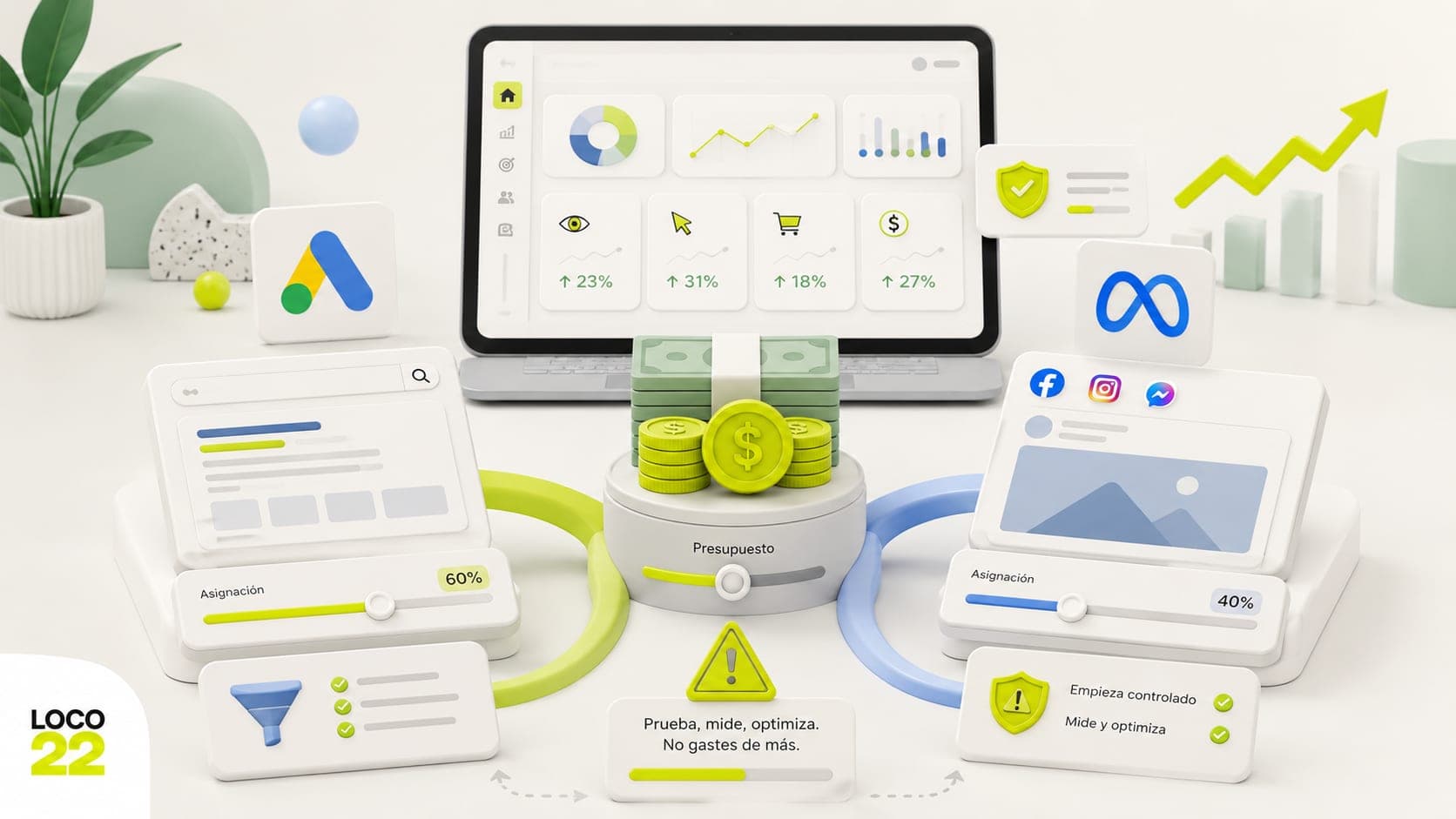
Short answer: for paid ads to be worth it, start with a minimum of USD 500 a month on a single platform — Google Ads or Meta Ads, not both — and stick with it for at least three months. Digital advertising has a reputation as a bottomless pit, and the reputation is earned: in the accounts we audit, a large share of the budget usually goes to clicks that were never going to buy.
But run well, paid ads are the most measurable growth lever there is: every dollar invested can be traced to a sale or a lead. In this guide we talk real numbers: how much to invest, how to split it between platforms, what to expect in the first quarter, and the signs that your campaigns are being mismanaged.
Key takeaways
- The recommended minimum budget to start on Google Ads or Meta Ads is USD 500 a month on a single platform, on top of the management fee.
- Google Ads captures demand that already exists (people searching for what you sell); Meta Ads creates new demand (it interrupts with something desirable). You pick based on how people buy from you.
- The first quarter of ads has three phases: learning (month 1), optimization (month 2), and a stable cost per acquisition (month 3). Positive ROI in week one is a red flag, not a win.
- Most visitors don't buy on their first visit: without remarketing campaigns, a large chunk of ad spend goes to waste.
- USD 500 a month is a floor for testing, not a guarantee: Meta wants roughly 50 results per week per ad set and Google's automated bidding works best with about 30 conversions a month. Do the math with your own cost per result before you commit.
- Set up conversion tracking before spending anything: without it, neither platform can optimize and you can't tell a good month from a bad one.
- Ads amplify what you already have: if the landing page doesn't convert, raising the budget just speeds up the losses.
- Before investing, calculate your maximum cost per acquisition: how much you can pay for a customer without losing money. Without that number, there's no such thing as a well-managed campaign.
What's the minimum budget for Google Ads and Meta Ads?
Our honest recommendation: don't start with less than USD 500 a month in ad spend, on top of the management fee. That's not an arbitrary number — Google's and Meta's algorithms optimize for conversions and need a minimum volume of results per week to get out of the learning phase. With USD 150 split across three campaigns, neither the algorithm learns nor do you gather enough data to decide anything.
That's why it's better to put USD 500 into a single platform and a single offer than to spread USD 200 across three fronts. And if your industry has expensive clicks — insurance, legal services, B2B software — the real minimum can be higher: when every click costs several dollars, USD 500 buys few visits and conclusions take longer to arrive.
The math behind the minimum: why USD 500 is a floor, not a promise
Both platforms use machine learning to decide who sees your ads, and that learning needs a steady flow of results to work with. The usual rules of thumb: Meta aims for about 50 optimization events (the result you chose to optimize for) per ad set in a rolling 7 days, and Google recommends around 30 conversions in 30 days before switching to automated bidding like Target CPA. Fewer than that and the system keeps guessing — what Meta labels "learning limited."
The formula is simple: events needed multiplied by what each event costs you. Illustrative numbers: if a lead costs USD 10, reaching 50 leads a week takes about USD 500 a week — roughly USD 2,000 a month. With USD 500 a month you'd collect about 50 leads in a whole month, not in a week. That doesn't mean ads won't work at that budget; it means you have to choose accordingly.
- On Meta, optimize for a cheaper event earlier in the funnel — a WhatsApp conversation started, a form submitted, an add-to-cart — instead of the final purchase, so the algorithm gets enough signals.
- On Google Search, a tight set of high-intent keywords can reach roughly 30 conversions a month at a few tens of dollars each — a far better fit for USD 500 than a broad Meta campaign optimizing for purchases.
- Run one campaign and one ad set. Every extra one splits the same budget and pushes each below the threshold.
- Don't touch budgets or audiences every few days: significant edits send the campaign back into learning.
Those thresholds are guidance from the platforms and the wider industry, not hard limits, and your real cost per result depends on your industry and country. Use them as a way to sanity-check a plan, not as a promise of results.
Set up tracking before you spend a single dollar
The most expensive mistake is turning on campaigns before measuring what they produce. Without conversion tracking, Google and Meta optimize for clicks — the cheapest thing to deliver and the least valuable — and you're left guessing from impressions and reach.
- Define what counts as a conversion: a purchase, a submitted form, a click-to-call, or a WhatsApp click if that's how your customers contact you.
- Install the conversion tag in Google Ads (through Google Tag Manager or GA4) and the Meta Pixel — ideally with Meta's Conversions API too, since browser tracking alone loses events.
- Respect consent: in many countries you need a cookie banner and consent mode before tags can fire, and unconsented traffic won't show up in your numbers.
- Test it: complete a real conversion yourself and confirm it appears in both platforms before you add budget.
Google or Meta? It depends on how people buy from you
Google Ads is advertising built on intent: you pay to show up when someone is already searching for what you sell. Meta Ads (Facebook and Instagram) is advertising built on attention: you pay to interrupt the scroll of someone who wasn't looking for you yet. They're different tools for different moments in the customer journey.
- Google Ads captures demand that already exists: people searching for "plumber in Cordoba" or "invoicing software." Ideal for services with active search intent and urgency.
- Meta Ads creates demand: it interrupts with something desirable the user wasn't looking for. Ideal for visual products, impulse purchases, and brand building.
- The classic combo that works: Meta to build awareness, Google to capture people who later search for you, remarketing on both to close the deal.
How should you split the budget between Google and Meta?
With USD 500 a month, don't split it: pick the platform that best fits how people buy from you and put everything into it for a full quarter. Splitting starts to make sense from around USD 1,000 a month, when each platform can get enough budget to learn on its own.
A simple rule for once you can split: if you sell a service people search for urgently (plumber, accountant, software), go 70% Google and 30% Meta. If you sell a visual or impulse product (apparel, home decor, food), flip it. And in any split, set aside 10% to 20% for remarketing — it's consistently the cheapest ad spend and the one that converts best.
What to really expect in the first quarter
Paid ads aren't an instant money machine: they're a system that needs calibrating. Here's what a normal quarter of well-managed campaigns looks like:
Month 1: learning
Campaigns gather data and cost per result is high. That's normal, and it's the price of entry: the algorithm is testing audiences, ads, and schedules. Resist the urge to touch everything every three days — every big change resets the learning phase and sends you back to square one.
Month 2: optimization
With data in hand, you cut what's not performing: keywords that bring in window-shoppers, audiences that click but don't buy, dead time slots. Cost per result starts to drop and the winning ads take a bigger share of the budget.
Month 3: forecasting
By now there's a stable cost per acquisition you can project from: "each lead costs me this much, each sale costs that much." Only now does it make sense to decide whether to scale, hold steady, or rethink. Anyone who promises you positive ROI in week one is either selling you smoke — or about to burn your brand with aggressive offers.
How much can you pay per customer? Do the math first
Before you put a single dollar into ads, run this calculation: margin per sale times closing rate equals your maximum cost per acquisition. In round numbers: if a customer leaves you USD 100 in margin and you close 1 out of every 5 inquiries, you can pay up to USD 20 per lead to break even — and you should aim for half that to actually make money.
If your customers buy from you again (recurring purchases, subscriptions, repeat business), you can afford to pay more to acquire them, because their value isn't one sale — it's several. This five-minute calculation is the difference between managing a campaign and just watching it: without a defined maximum cost, any result can "look fine."
4 signs your ad campaigns are being mismanaged
If you already have campaigns running — your own or with an agency — these four signs will tell you if money is leaking out:
- You get reports on clicks and impressions, but nobody talks about sales or cost per lead.
- There are no remarketing campaigns (most visitors don't buy on the first visit; if you're not following up with them, you paid for nothing).
- Traffic lands on your generic homepage instead of a landing page specific to the offer.
- You've never been shown an A/B test: same ads for the past six months.
The part nobody budgets for: the landing page
You can have the best campaign in the world: if it lands on a slow, confusing page with no clear call to action, the budget evaporates. Before you raise your ad spend, make sure the page receiving that traffic actually converts. Doubling your landing page's conversion rate is a one-time cost; doubling your ad budget costs you every single month.
The minimum checklist before you turn campaigns on: the page loads fast on a phone with mobile data, the ad's message matches the page's headline — if the ad promises "20% off sneakers," it can't land on your generic homepage — and there's a single, visible call to action with no scrolling required. Three simple conditions that most of the accounts we audit fail to meet.
Ads don't fix a weak offer or a broken landing page: they amplify them.
Frequently asked questions
How much does a click cost on Google Ads?
There's no single number: cost per click on Google Ads depends on your country, your industry and the competition, ranging from a few cents in low-competition searches to several dollars in fields like insurance, legal, or software. That's why the metric that matters isn't the click — it's the cost per acquisition: how much each lead or sale costs you at the end of the funnel.
Should a small business start with Google Ads or Meta Ads?
If people already search for what you sell (a plumber, an accountant, software), start with Google Ads: you pay to appear at the moment of intent. If your product is visual or bought on impulse (clothing, decor, food), start with Meta Ads. With a budget around USD 500 a month, pick one platform and stay with it for a full quarter instead of splitting it.
Is it worth running digital ads with less than USD 500 a month?
Generally, no: below USD 500 a month, Google's and Meta's algorithms don't gather enough conversions to optimize, and the results are just noise. If you can't reach that budget yet, there are better uses for your money: local SEO, email marketing to your existing customers, or improving your website's conversion rate. Running a small budget isn't running a cheap one — it's paying for data that never adds up to anything.
What is remarketing and why does it matter so much?
Remarketing means showing ads to people who already visited your website or interacted with your brand. It matters because of one simple fact: most visitors don't buy on their first visit. Without remarketing, you pay to attract people who leave and never come back; with remarketing, that first visit turns into a warm audience that costs less and converts more.
How much does an agency charge to manage Google Ads and Meta Ads?
The usual industry models are a fixed monthly fee or a percentage of ad spend. More important than the model is the proportion: if your ad spend is USD 500 and the fee costs about the same, the math doesn't work. And demand reports on sales and cost per lead, not clicks and impressions — that's where you see whether the management is worth what it costs.
Can I manage ads myself, without an agency?
You can, and with small budgets it's sometimes reasonable. The risks: the "smart" default settings that Google and Meta turn on tend to make you spend more, not spend better, and without experience you can burn months on well-known mistakes. If you're serious about it, set aside fixed hours every week; if you don't have them, a good account manager pays for themselves with what they save you.
How long does it take for digital advertising to show results?
The first metrics from Google Ads and Meta Ads show up within days, but reliable results take a full quarter: month 1 of learning, month 2 of optimization, and month 3 with a stable cost per acquisition. Evaluate your ads at the 90-day mark with complete data, not after a week of anxiety. Cutting a campaign too soon is the most common way to "prove" that ads don't work.
At loco22 we manage campaigns with a simple rule: every dollar invested has to be traceable to a sale or a lead. If you're about to start running ads — or you suspect your current account is burning money — ask us for a campaign audit: on a free call we'll show you what's working, what isn't, and how much you should actually be investing.
Found this useful? Add us as a preferred source in Google.