Web designBy Federico Noya · 11 min read
Outsourcing web design from the UAE or Saudi Arabia: what to check before you hire abroad
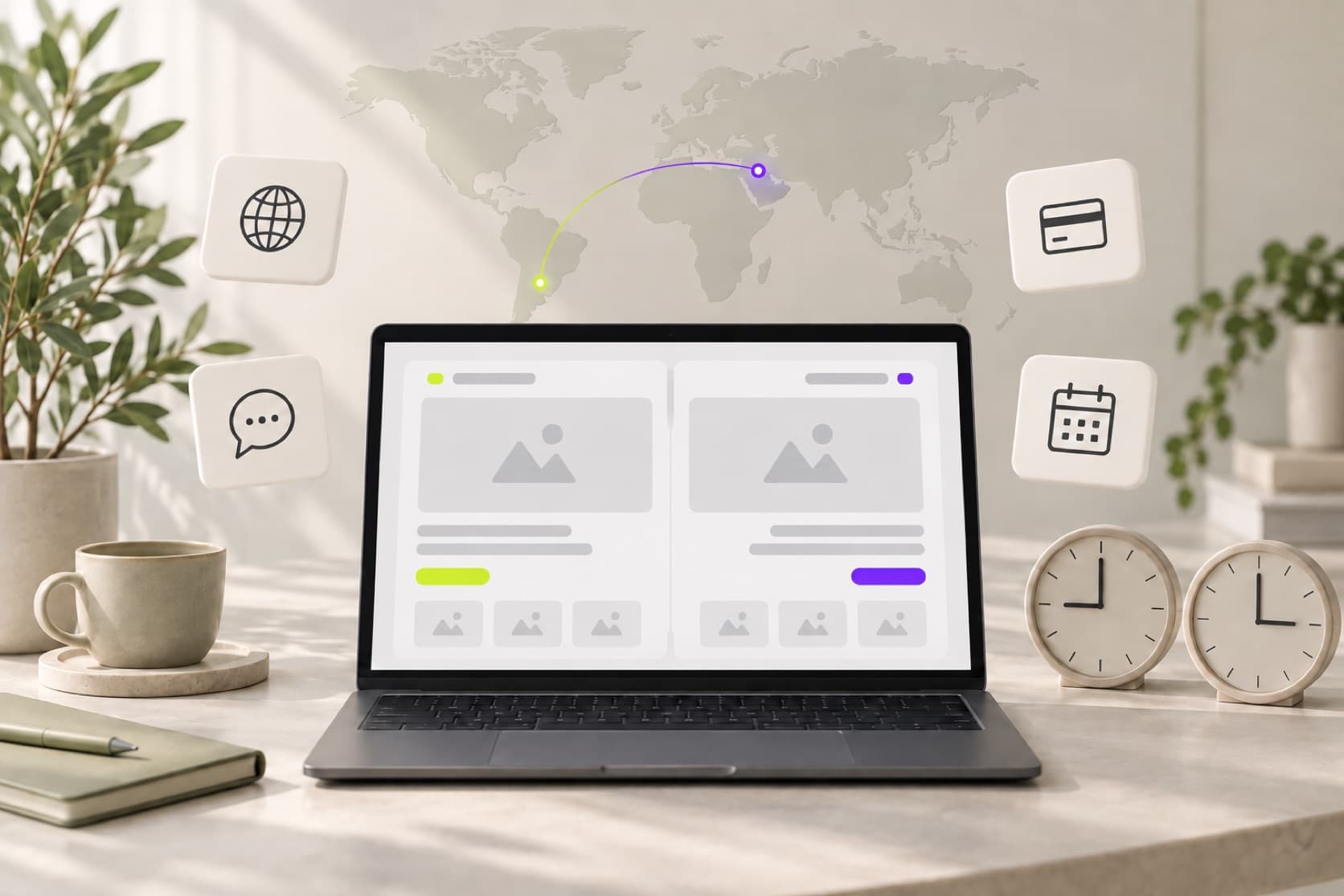
If you run a business in Dubai, Abu Dhabi, Riyadh or Jeddah and you've asked for website quotes, you already know the spread: local agencies with polished offices and numbers to match, and freelancer platforms where the price is fine and everything else is a gamble. A growing option sits in between: hiring an agency abroad that works in English, runs projects remotely and prices from a lower cost base. Done well, you get a senior team for less. Done badly, you get a site that breaks the moment someone switches it to Arabic.
Full disclosure: we're one of those agencies, a studio based in Buenos Aires, Argentina. We don't have an office in the Gulf and we won't pretend to. That's exactly why this guide is written from the buyer's side: it's the checklist we'd want you to run on us, and on anyone else outside the region you're considering.
Key takeaways
- Outsourcing works when the agency is built for async work: written updates, recorded walkthroughs and fixed milestones. From Latin America, you won't share the whole day — you share a few hours, and that's enough if the process is right.
- Buenos Aires is 7 hours behind Dubai and 6 behind Riyadh. The overlap is your afternoon, their morning: 3:00–6:00 pm in Dubai, 2:00–5:00 pm in Riyadh.
- Gulf-specific work is where foreign teams slip: a real bilingual English/Arabic site with right-to-left layout, local payment methods like mada, WhatsApp as the main channel, and the UAE and Saudi data protection laws. Ask about each one directly.
- Paying in US dollars carries no currency risk for you: both the dirham and the riyal are pegged to the dollar.
- The non-negotiables are the same as anywhere: the code, the domain and the hosting in your name, a written IP assignment, a fixed scope, and named people you can talk to.
Time zones: what the overlap actually looks like
Let's be concrete, because this is the first thing that decides whether outsourcing works. Buenos Aires runs on UTC−3 all year. Dubai is UTC+4 and Riyadh is UTC+3, and none of the three change their clocks. That puts Buenos Aires 7 hours behind the UAE and 6 behind Saudi Arabia.
- 8:00–11:00 am in Buenos Aires = 3:00–6:00 pm in Dubai = 2:00–5:00 pm in Riyadh. That's the daily window for calls and live reviews.
- The UAE works Monday to Friday; Saudi Arabia, Sunday to Thursday. Monday to Thursday line up with both, so four days a week have a shared window no matter where you are.
- The rest of the day works in your favor: feedback you send at the end of your afternoon gets worked on during our day, and you find it ready the next morning.
What this means in practice: don't hire an agency abroad that runs everything through calls. The ones that work well across time zones write things down. A short written update at the end of each day, a recorded video walkthrough when there's a design to review, a project board you can check any time, and milestones with dates. Calls are for decisions, not for status.
The Gulf-specific details that break foreign projects
Design and code quality travel well. What doesn't travel is local context. These are the points where an agency that has only built for Europe or the Americas is most likely to fall short, so ask about each of them before you sign.
Arabic and right-to-left
A bilingual site is not an English site with a translation plugin. Arabic reads right to left, so the whole layout has to mirror: navigation, icons that point in a direction, forms, tables, carousels. Arabic also needs a typeface designed for it, with line heights that don't clip the script. Ask the agency to show you how they build the Arabic version: it should be a real right-to-left layout, with separate URLs per language so each version can rank on its own.
Then ask who writes the Arabic. The honest answer from a foreign agency is: a native speaker you approve, whether that's someone on your team, a copywriter you already work with, or one they bring in. Our position is simple: we build and test the right-to-left layout; the Arabic copy is written or reviewed by a native speaker you sign off on. Be wary of anyone who says machine translation is good enough for a customer-facing site.
Payments that people in the Gulf actually use
If you sell online, the checkout has to accept how your customers pay. In Saudi Arabia that means mada, the national debit network, alongside Apple Pay and credit cards; across the region, buy-now-pay-later services like Tabby and Tamara are common. Which payment gateway you can use depends on your bank and acquirer, so a good agency starts by asking which provider you have, not by assuming Stripe. Ask for a checkout they've integrated with a gateway similar to yours.
WhatsApp, Maps and how customers reach you
In the Gulf, a lot of customers would rather message you on WhatsApp than fill in a contact form. Your site should make that the obvious action, and if you get volume, the conversation can be handled by an assistant that answers common questions and hands over to a person. If you have a physical location, your Google Business Profile matters as much as the website: correct name, address and phone in both languages, the same everywhere.
Data protection and data residency
Both countries now have their own personal data laws: the UAE's Federal Decree-Law No. 45 of 2021 on personal data protection, and Saudi Arabia's Personal Data Protection Law, overseen by the Saudi Data and AI Authority (SDAIA) and enforced since September 2024. Some sectors also have rules about where data can be stored. A foreign agency should build the consent flows, privacy pages and forms with these in mind and host where your compliance requires — but the legal reading is for your lawyer, not for your web agency. Ask the agency how they handled it before, and confirm the requirements with your legal advisor.
E-invoicing if you sell in Saudi Arabia
Businesses registered for VAT in Saudi Arabia have to issue electronic invoices under ZATCA's e-invoicing rules, known as Fatoora. If your online store generates invoices, it has to connect to a compliant invoicing or accounting system. The agency doesn't need to be an expert in tax, but it does need to know this exists and plan the integration from the start, not discover it after launch.
Showing up in AI answers, in both languages
More and more people ask ChatGPT, Gemini or Perplexity for recommendations before they ever open Google. Whether those assistants mention your business depends on how clearly your site states who you are, what you do and where you operate. With a bilingual site, that work has to happen in English and in Arabic. It's what we call GEO, and it's worth asking any agency how they approach it.
10 questions to ask an agency outside the Gulf
Use these on anyone you shortlist. The answers matter less than how concretely they come back: a team that does this well answers with names, dates and examples.
- 1. Who exactly will work on my project, and will I meet them? Ask for names and roles, and whether any part is subcontracted.
- 2. What's our daily overlap, and how do you work outside it? You want a specific window and a written routine: daily updates, recorded reviews, a shared board.
- 3. How do you build the Arabic version? Look for a real right-to-left layout and separate URLs per language, not a translation plugin.
- 4. Who writes and reviews the Arabic copy? A native speaker you approve is the right answer.
- 5. Which payment gateways have you integrated, and do you support mada and BNPL? Ask to see one live.
- 6. How do you handle the UAE and Saudi data protection laws on forms and cookies? They should describe what they build and send you to your lawyer for the legal side.
- 7. Will the code, domain, hosting and analytics be in my name from day one? The only acceptable answer is yes.
- 8. Does the contract include an explicit assignment of intellectual property to my company? Have your lawyer check it, especially across jurisdictions.
- 9. Is the price fixed, and what exactly is in and out of scope? Pages, languages, integrations and revision rounds, all in writing.
- 10. Can I see live sites and talk to a client? Live URLs let you check speed and mobile behavior yourself.
Payments, currency and VAT
Paying an agency abroad is simpler than it sounds. We invoice in US dollars through our US LLC and get paid by international bank transfer. Projects are usually 50% up front and 50% on delivery; monthly services are billed month to month. Because the UAE dirham is pegged to the dollar at 3.6725 and the Saudi riyal at 3.75, a price quoted in dollars today is the same in your currency when you pay the final invoice.
On tax: the UAE charges 5% VAT and Saudi Arabia 15%. When a VAT-registered business buys services from a supplier abroad, the reverse-charge mechanism usually applies, meaning you account for the VAT yourself rather than the supplier charging it. How that applies to your company is a question for your accountant; the point is that it's a standard situation, and an agency used to foreign clients will give you invoices with everything your accountant needs.
For reference, our published prices apply the same in every market: landing pages from USD 800, business websites from USD 1,500, WordPress sites from USD 1,200, online stores from USD 3,000, SEO + GEO from USD 500 a month, digital marketing from USD 400 a month and AI automation from USD 600. A bilingual site adds a second language to the scope, so it's quoted as part of the project.
When hiring abroad is not the right call
Being honest about this is part of choosing well. An agency outside the region is probably the wrong fit if:
- You need people on site: photo shoots at your locations, in-person workshops, someone in your office.
- Your project needs regulatory approvals or government integrations that only a locally licensed provider can handle.
- You need the Arabic copy written from scratch and have no native speaker to write or approve it.
- Nobody on your side can give the project an hour or two a week. Async work depends on timely feedback; an absent client stalls any team.
If none of those apply, the math is straightforward: a senior team, fixed prices, the code in your name, and a process designed for working across time zones. We wrote down how that works for businesses in the UAE and Saudi Arabia on a dedicated page.
Frequently asked questions
Is it cheaper to outsource web design from the UAE or Saudi Arabia?
Often, yes, because agencies in countries with lower operating costs can staff a project with senior people and still price below a comparable local quote. The work itself takes the same hours anywhere, so compare proposals line by line: the savings should come from the agency's costs, not from a smaller scope or skipped testing.
What is the time difference between Buenos Aires and Dubai or Riyadh?
Buenos Aires is 7 hours behind Dubai and 6 hours behind Riyadh, all year, since none of the three cities change their clocks. The shared window is 8:00–11:00 am in Buenos Aires, which is 3:00–6:00 pm in Dubai and 2:00–5:00 pm in Riyadh, Monday to Thursday.
Can a foreign agency build a bilingual Arabic and English website?
Yes, if it builds a real right-to-left layout for Arabic with separate URLs per language. The Arabic copy should be written or reviewed by a native speaker the client approves; ask who that will be before signing.
How do I pay a web agency based in Argentina?
We invoice in US dollars through our US LLC and are paid by international bank transfer. Since the UAE dirham and the Saudi riyal are pegged to the dollar, there's no currency risk. How VAT and the reverse charge apply to your company is a question for your accountant.
Who owns the website if an agency abroad builds it?
Whoever the contract says. Make sure it includes an explicit assignment of intellectual property to your company, and that the domain, hosting, repository and analytics accounts are created in your name from day one.
Found this useful? Add us as a preferred source in Google.