Web designBy Federico Noya · 8 min read
.co, .com.co or .com? The Colombian domain trap
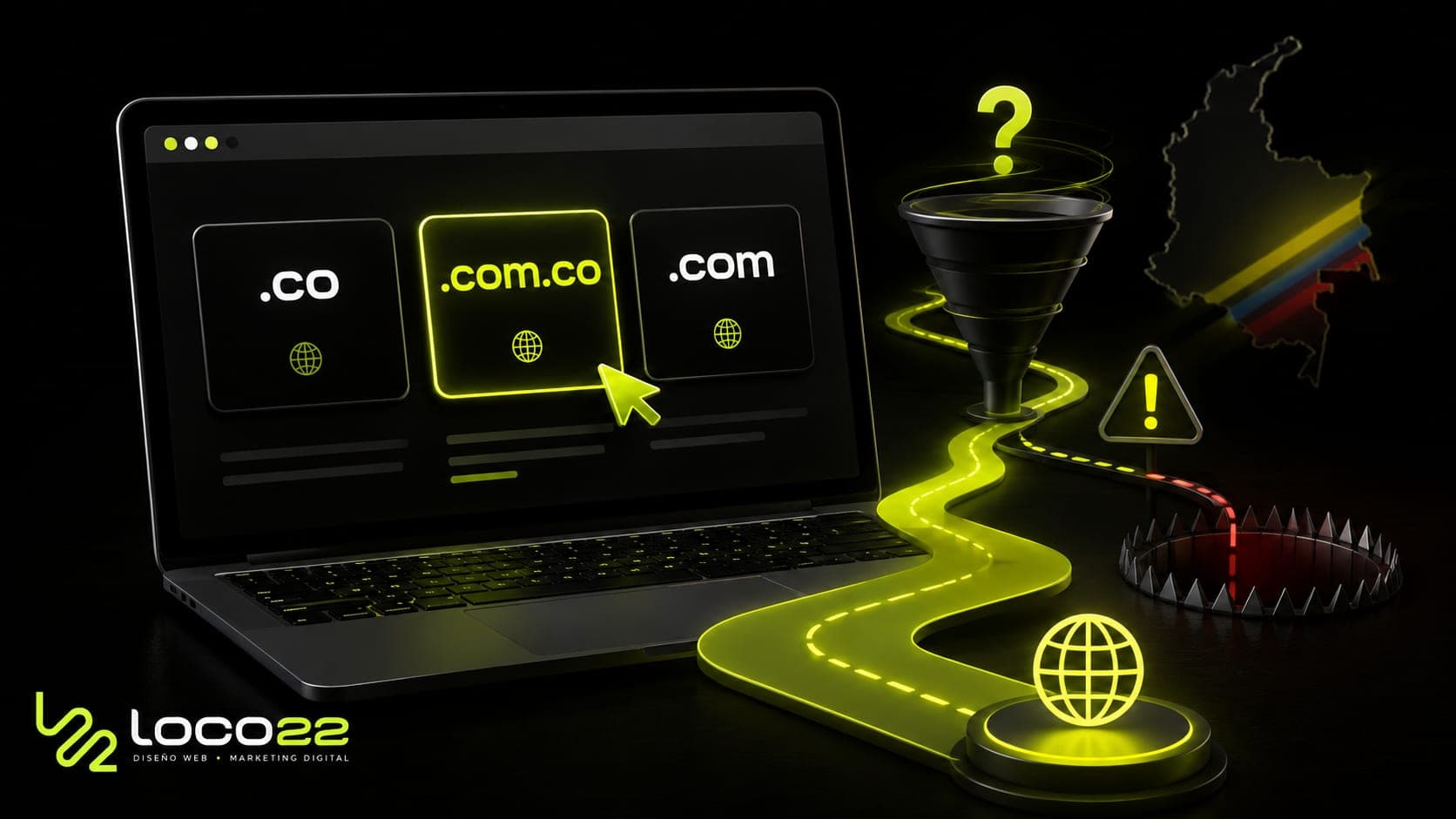
The short answer: if your business sells in Colombia and your brand's .com is available, buy the .com. If you want an explicit local signal on a tight budget, .com.co does the job perfectly. And .co — the «Colombian» domain? Paradoxically, it's the most expensive of the three, because Colombia leased it to the world as the abbreviation for «company». In this guide we cover what each ending really is, the three traps we keep seeing businesses fall into — renewal pricing, the domain registered under someone else's name, and the variants you didn't buy — and how to choose for your case.
Key takeaways
- .co is Colombia's country-code domain, but since 2010 it's been sold worldwide as the abbreviation for «company» — which is why its renewal costs two to four times more than a .com.
- Google treats .co as a generic domain, just like .com or .io: the ending neither helps nor hurts your ranking in Colombia.
- .com.co is the classic local variant: it costs about the same as a .com and tells users, unambiguously, that your business is Colombian.
- The most expensive trap isn't picking the wrong ending: it's the cheap first year with triple-price renewal, and the domain registered under your provider's name.
- Register the obvious variants of your domain and redirect them to the main one: customers and emails get lost in the ending you didn't buy.
- Whichever you choose: registrant in your name, your own registrar account, and auto-renewal switched on.
What each ending really is (and why the «Colombian» one is the pricey one)
.co: Colombia's domain, sold to the world
.co is Colombia's ccTLD — its country domain, like Argentina's .ar or Mexico's .mx. In 2010 it was relaunched with open registration: anyone in any country can buy one, no Colombian residency or company required. The tech world adopted it as shorthand for «company» — thousands of startups use it, and even X's links travel over t.co. That global demand has a direct consequence for the everyday Colombian business: .co is priced internationally. The first year usually comes discounted, but renewal runs around USD 25–40 a year depending on the registrar, versus USD 10–20 for a .com.
.com.co: the local variant
.com.co is the third-level registration meant for companies operating in Colombia — the one used by banks and much of the traditional business fabric. It costs about the same as a .com, and its strength is clarity: nobody outside Colombia uses it, so it tells customers exactly where your business operates. If you only sell inside the country, that signal works for you, not against you.
.com: the global standard
.com is still the ending people type by default when they remember a brand. It's cheap, neutral, and works as well in Bogotá as in Miami. Its only problem is availability: getting a short, clean .com is harder every year. Hence the practical rule: if your brand's .com is free, buy it now — even if you end up using another ending as your main one. It won't be there tomorrow.
Trap 1: the cheap first year
Registrars sell .co at USD 1–10 for the first year and renew at the real price. It's not a scam — it's acquisition marketing — but the business that bought «cheap» discovers the true price twelve months later, when the domain is already printed on business cards, invoices and bags. At that point nobody migrates: you pay. Before buying any domain, look at the renewal price, not the registration price. And if the brand is serious, pay for two or three years up front: it locks the price and keeps you away from the expiry date.
Trap 2: the domain in someone else's name
It's the most expensive problem we find in audits, and the one nobody sees coming: the domain was registered by the agency or the hosting company in their own account, under their name. While the relationship is good, nothing hurts. When it breaks — over price, over service, because the provider disappears — your address on the internet becomes a hostage in the negotiation. The domain's registrant must be you or your company; your provider can be the technical contact and manage it day to day, but ownership is not something you delegate. If you don't know today which registrar holds your domain or which account manages it, that's item number one on this guide's to-do list.
Trap 3: the variants you didn't buy
Your customer doesn't memorize your domain: they guess it. And they guess differently depending on the day. If your site is empresa.com.co, sooner or later someone will type empresa.co or empresa.com — and on the other side there may be nothing, or worse, someone else. A competitor or a speculator can register the variant and keep your visits and your emails. In fact, part of .co's value lies in the .com typos it receives for free.
- Buy the variants a customer could type from memory: the sibling ending and, if it applies, your brand's obvious typo.
- 301-redirect all of them to the main domain: one website, one brand authority.
- Email lives only on the main domain. A message sent to the variant that doesn't exist bounces — and a bounced inquiry is a sale that never happened.
What about SEO? What Google actually looks at
Here's the part that dismantles half of all domain sales pitches: Google treats .co as a generic domain — it's on its list of country-code domains «treated as gTLDs», alongside .io and .tv — so a .co ranks neither better nor worse in Colombia because of its ending. What ranks you in Colombian searches is the content on your site, your Google Business Profile, your reviews, and the consistency of your contact details. The ending is a brand and budget decision, not a ranking one.
The same goes for AI search: ChatGPT or Perplexity cite businesses for what their website says and how consistent the brand is across the internet, not for the domain ending. Choose your domain for clarity, price and ownership — and save the ranking effort for where it's actually decided.
Which one to choose, case by case
A business that sells only in Colombia
.com.co is the rational choice: it costs like a .com, it screams Colombia, and no customer will blink at it. If the .com is also free, buy it and redirect it — about USD 15 a year of insurance against confusion.
A brand with plans beyond Colombia
.com as the main domain, no hesitation: it's the one ending you never have to explain in any country. The local variants — .com.co or .co — get bought and redirected, so the Colombian customer who types them still arrives.
A short brand with startup spirit
.co as an identity works — thousands of startups prove it — and if your brand is short and memorable it can look great. Just do it knowing what it is: an aesthetic decision with a premium renewal cost, not a technical advantage. Absorb that cost as a branding cost, and if your name's .com ever frees up, buy it.
Checklist before buying (or renewing)
- Registrant in your company's name or your own — never the provider's. The agency can be the technical contact, not the owner.
- Your own registrar account: your username and password, even if someone else handles the day-to-day.
- Auto-renewal on and a valid payment method: expired domains go to auction, and buying them back is painfully expensive.
- Renewal price checked before buying — the first-year price is advertising.
- Obvious variants registered and 301-redirected to the main domain.
- Company email only on the main domain, and tested: send yourself a message at the most likely typo and see what happens.
Your domain is your business's address. If it's not in your name, your business lives on borrowed ground.
Frequently asked questions
Is the .co domain Colombian?
Yes: .co is Colombia's country-code domain (ccTLD). Since 2010 it has open registration and is marketed worldwide as the abbreviation for «company», with no residency requirement. Because of that global adoption, Google treats it as a generic domain: using it doesn't make your website «more Colombian» in the eyes of search engines.
How much does a .co domain cost?
The first year is usually discounted — USD 1 to 10 depending on the registrar — but the real renewal runs around USD 25–40 per year. A .com or a .com.co costs between USD 10 and 20 a year. The number to compare before buying is always the renewal price, not the first-year price.
Is .com.co worse for SEO?
No. Google doesn't reward or punish the domain ending: you rank in Colombia with relevant content, a complete Google Business Profile, reviews, and consistent contact details. On top of that, .com.co costs less than .co and clearly communicates that your business operates in Colombia. Choose it for clarity and price with peace of mind.
Can I change my domain later?
You can: 301 redirects from the old domain, plus updating Google Business, profiles, invoices and email. But it costs months of transition, some rankings, and operational work. Changing domains is a house move — possible, but expensive. Choosing well today is far cheaper.
My agency registered the domain in its name — what do I do?
Ask them to transfer ownership: changing the registrant or pushing the domain to an account of yours is a standard procedure at any registrar. A serious agency does it without drama, because the domain was never part of their service — it's yours. If they refuse or stall, that resistance tells you everything you need to know about the provider.
Do I have to buy every ending?
No. Buy the main one plus the variants a customer would type from memory — in Colombia, typically the .com.co/.co pair, or the .com if it's free — and redirect them. For a small business, two or three well-redirected domains are plenty of protection; collecting endings is money that works harder in content.
At loco22, the domain is registered in your name from day one: the code is yours, and so is the address. If you don't know which registrar holds your domain, whose name it's under, or what your next renewal will cost, write to us — checking takes minutes and prevents the most expensive problem in this guide.
Found this useful? Add us as a preferred source in Google.